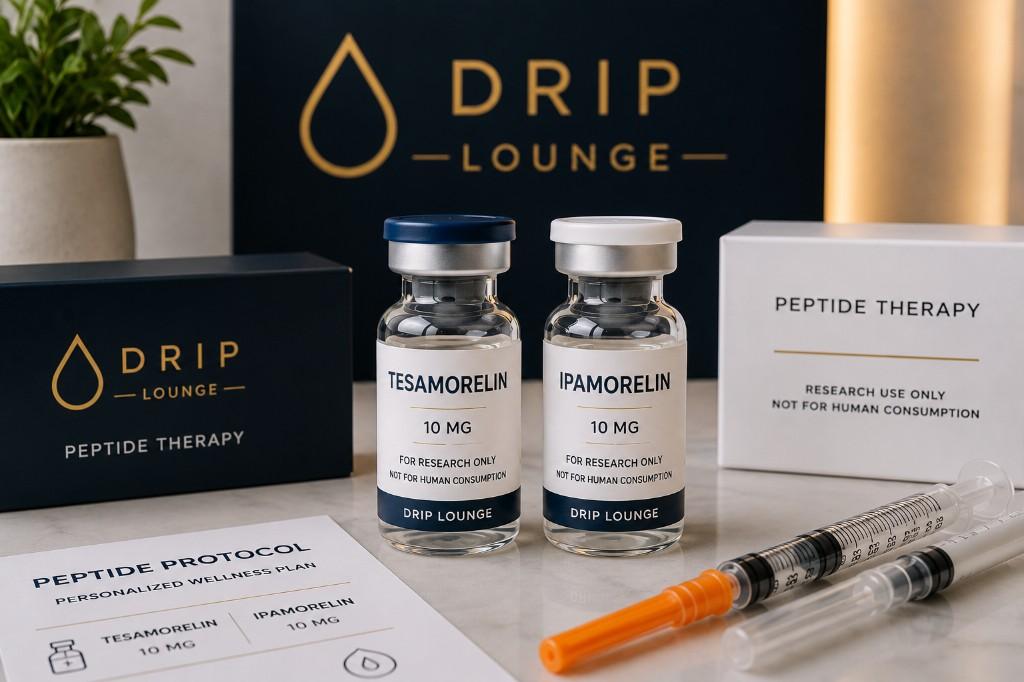
Peptide therapy can be used safely for an appropriate patient when the compound is legally available, sourced through a properly licensed pharmacy, prescribed after clinical evaluation, and monitored by a qualified healthcare provider. The risk increases significantly when products come from unverified online sellers, lack reliable quality documentation, or are used without medical supervision.
Interest in peptides has expanded across weight management, recovery, sleep, body composition, skin wellness, metabolic health, and healthy-aging programs. At the same time, consumers can now find injectable products online labeled “research use only,” often without a prescription, medical screening, or clear information about who manufactured the product.
That creates an important distinction: the word peptide does not tell you whether a product is safe. The three variables that matter most are sourcing, product quality, and clinical supervision.
At Drip Lounge, peptide wellness is approached as provider-guided care rather than a direct product purchase. This guide explains how peptide products differ, what quality documentation should exist, and how to identify red flags before starting treatment.
Medically reviewed by: Megan Nickerson, DNP · Last medically reviewed: August 2026
Medical disclaimer: This article is for educational purposes and does not replace medical advice, diagnosis, or treatment. Eligibility, product availability, dosing, and monitoring must be determined by a licensed healthcare provider.
Key Takeaways
- Some peptide medications have completed the FDA approval process for specific medical indications.
- Compounded peptides are not FDA-approved and are not reviewed by FDA for safety, effectiveness, or quality before reaching patients.
- A 503A pharmacy and a 503B outsourcing facility operate under different regulatory frameworks.
- “Research use only” does not prove that a product is pure, sterile, or suitable for human use.
- Peptide safety depends on the patient, the specific compound, the pharmacy, the formulation, storage, dosing, and ongoing monitoring.
- A laboratory report is useful only when it can be connected to the exact product and lot being dispensed.
Read more: Peptides for Weight Loss 2026: What Actually Works
What “Peptide Therapy” Actually Means
Peptides are short chains of amino acids. Many naturally occurring peptides function as signaling molecules, helping regulate processes such as metabolism, hormone activity, digestion, tissue signaling, and immune function. Therapeutic peptides are designed or selected to influence particular biological pathways.
However, products described online as “peptide therapy” can belong to very different categories.
| Peptide category | What it means | Level of oversight |
|---|---|---|
| FDA-approved peptide medication | A drug reviewed and approved for a defined indication, formulation, dose, manufacturing process, and labeling | FDA approval, regulated manufacturing, prescribing information and post-market oversight |
| Compounded peptide | A patient-specific or clinically supplied preparation made by an eligible compounding pharmacy or outsourcing facility | Regulated under the applicable 503A or 503B framework, but not FDA-approved |
| Online research peptide | A product sold for laboratory or research purposes, frequently through a direct online checkout | May have no verified clinical pathway, prescription review, pharmacy oversight, or assurance of suitability for human use |
“Medical peptide” is not a formal FDA classification. In this article, the phrase refers to a peptide prescribed or ordered through a legitimate clinical process and dispensed through a regulated channel—not simply a product presented with medical-looking packaging.
FDA states clearly that compounded drugs are not FDA-approved, meaning the agency does not verify their safety, effectiveness, or quality before they are marketed. FDA also notes that poor compounding practices can result in contamination or too much or too little active ingredient.
FDA-Approved Peptides vs. Compounded Peptides
FDA-approved peptide medications have been evaluated for specific uses. Approval does not mean a drug is risk-free, but it does mean the product has gone through a formal review of its intended use, clinical evidence, manufacturing, labeling, and quality controls.
Compounding serves a different purpose. It may be used when a patient has a medical need that cannot be met by an available FDA-approved product. Compounded products can be clinically valuable, but they do not carry the same premarket FDA review.
Under Section 503A, qualifying drugs are generally compounded in response to valid, patient-specific prescriptions. These pharmacies are primarily overseen day to day by state boards of pharmacy and are exempt from federal current good manufacturing practice requirements when they meet 503A conditions.
A 503B outsourcing facility voluntarily registers with FDA, may compound certain sterile drugs for healthcare facilities, must comply with current good manufacturing practice requirements, reports specified information to FDA, and is inspected according to a risk-based schedule. Registration alone should not be presented as FDA approval or endorsement, but it provides a different level of federal oversight than the standard 503A framework.
Read more: BPC 157 Results Timeline: How Long Does BPC-157 Take to Work?
Research Peptides vs. Medical Peptides
The phrase “research use only” can sound scientific, but it should not be interpreted as a quality credential.
A research-use label normally indicates that the product is not being offered through an approved human-treatment pathway. It does not confirm:
- clinical suitability;
- sterile manufacturing;
- accurate potency;
- verified identity;
- legal prescription dispensing;
- appropriate storage;
- or medical monitoring.
In a 2025 warning letter to an online peptide seller, FDA stated that products can still be considered drugs intended for human use despite labels such as “research use only” or “not for human consumption.” FDA also warned that products sold outside regulatory safeguards could be contaminated, counterfeit, contain varying amounts of active ingredient, or contain a different ingredient altogether.
The practical difference is not the design of the vial or website. It is whether a licensed provider evaluated the patient, whether an identifiable regulated pharmacy produced or dispensed the preparation, and whether the exact product can be traced and documented.
Why Sourcing Is the Real Safety Variable
When a person receives an injectable peptide, the name printed on the label is only one part of the safety question. The provider also needs confidence that the vial contains the stated compound at the intended concentration and has been produced, handled, shipped, and stored appropriately.
Unverified sourcing can introduce risks involving:
- incorrect identity;
- inaccurate concentration;
- degradation during storage or shipping;
- microbial contamination;
- bacterial endotoxins;
- unwanted impurities;
- misleading or reused laboratory reports;
- and unclear beyond-use dating.
Injectables require especially careful controls because they bypass many of the body’s natural protective barriers. FDA has warned compounders to use ingredients appropriate for sterile preparations after receiving adverse-event reports associated with injectable NAD+ products. The agency connected reported reactions with possible excessive endotoxin exposure and emphasized the importance of knowing ingredient and supplier quality.
This is why a premium clinical experience cannot be built around anonymous sourcing or the lowest available online price.
Read more: Peptide Therapy for Depression: Can CJC-1295 and BPC-157 Improve Mental Health?
Purity and Testing: What “Pharmaceutical-Grade” Should Mean
“Pharmaceutical-grade” is frequently used as a marketing phrase. Patients should look beyond the phrase and ask what objective documentation supports it.
At Drip Lounge, a quality-focused sourcing review should examine eight core areas:
| Quality factor | What it should help verify |
|---|---|
| Identity | Whether the compound is actually the peptide stated on the label |
| Purity | The proportion of the intended peptide relative to detectable impurities |
| Potency or concentration | Whether the vial contains the labeled amount |
| Sterility | Whether viable bacteria or fungi are absent from a sterile injectable |
| Endotoxin testing | Whether bacterial endotoxin levels are appropriately controlled |
| Stability data | Whether storage conditions and beyond-use dates are supported |
| Batch-specific COA | Whether the certificate matches the exact lot dispensed |
| Impurity profiling | Whether relevant degradation products or impurities are identified and quantified |
A Certificate of Analysis, or COA, is not automatically proof of quality. It should identify the lot number, testing laboratory, test date, methods used, specifications, and actual results. A generic PDF used for multiple products or batches offers far less assurance than a lot-matched report from an identifiable laboratory.
Patients can ask:
- Which licensed pharmacy dispensed the medication?
- Is it a 503A pharmacy or a 503B outsourcing facility?
- Can the exact vial be traced to a lot number?
- Is a batch-specific COA available?
- What testing was completed for identity, potency, sterility, and endotoxins?
- What is the pharmacy-assigned beyond-use date?
- How should the product be refrigerated, transported, and handled?
- Who should be contacted if the package arrives warm, damaged, or compromised?
Testing does not make every peptide clinically appropriate. It helps answer the narrower question of whether the physical product matches the expected quality profile.
Read more: KPV Peptide: Anti-Inflammatory Benefits Explained
Storage, Reconstitution, and Contamination Risk
Peptide handling requirements vary by formulation. Some products may require refrigeration, protection from light, careful reconstitution, or use within a defined period.
Patients should follow the exact instructions supplied by the dispensing pharmacy and provider. They should not rely on generic instructions from social media, online forums, or another clinic’s protocol.